


Almost everyone knows it: in a hotel, at a friend's place or in a holiday house, you sleep badly on the first night. From the second night on it gets better. That is no coincidence and no imagination.
The effect has a name
Sleep researchers call it the first-night effect. In an unfamiliar environment, one half of the brain stays in a kind of readiness — lighter sleep, faster reaction to noises. A safety mechanism that made evolutionary sense and in a hotel room only gets in the way.
There is little you can do about that. What you can influence is everything else.
What disturbs you most when travelling
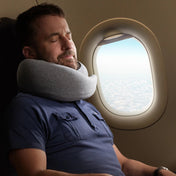
It is rarely the big things. It is the unfamiliar pillow that is too high or too soft. The light that comes through the wrong curtains. The air conditioning that hums. The neck that tips forward in an aeroplane seat.
Each of these small things would be harmless on its own. Together with the first-night effect, they add up.
The pillow is the thing you can take with you
You cannot change the hotel room, and usually not the air conditioning either. What you can bring is the support for your head — and with it, of all things, the one point that works for eight hours every night.
That is exactly what we developed the TravelFit for: ergonomically shaped, but small enough for a rucksack. The bundle adds a case and a sleep mask — against the second big problem when travelling, namely light you have no influence over.
And your hair
One point that is more annoying when travelling than at home: you have less time in the morning and none of your usual things. The DreamCap is made for this — it reduces friction during the night so that frizz and flattened strands make less work in the morning.
Five things that really help when travelling
- Stick to your own time, as long as the time zone allows it. The rhythm matters more than the number of hours.
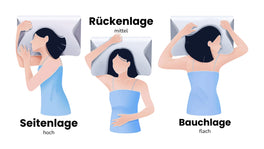
- Take your own pillow height with you — or the pillow itself. It is the only part of the bed you control.
- Expect light. Hotel curtains almost never close completely. A mask weighs nothing.
- Turn the air conditioning down, not off. Still air quickly becomes too warm, and above 24 degrees sleep suffers measurably.
- Plan for the first night. If you know it will be worse, you put the important appointment on the second day.
The last point sounds banal and is the most effective. You cannot switch off the first-night effect — but you can plan around it.